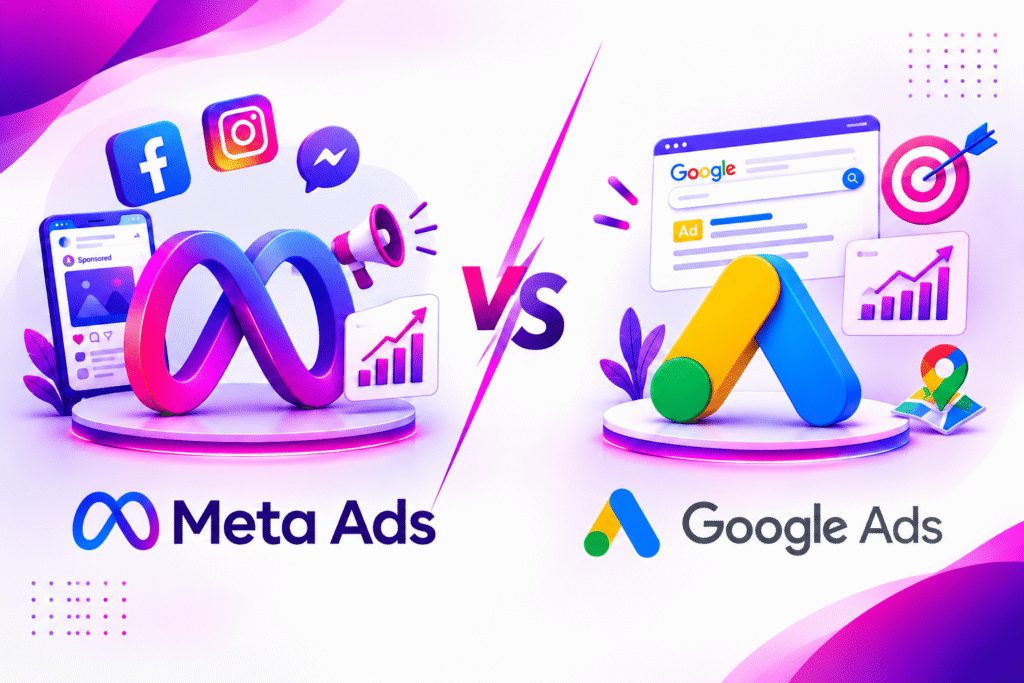

Businesses today need more than visibility to grow. They need to reach the right audience, communicate the right message, and turn attention into genuine enquiries and sales. Meta Ads help businesses achieve this by combining audience targeting, engaging creatives, flexible budgets, and measurable campaign performance.
The real value of paid social advertising is not simply generating a large number of leads. It is attracting prospects who are genuinely interested in a product or service. With the right strategy, businesses can identify relevant audiences, deliver personalized messages, and continuously improve campaign performance.
For businesses looking to generate consistent enquiries, a well planned advertising strategy can become an important part of the overall digital marketing process.
What Are Meta Ads?
Meta’s advertising ecosystem allows businesses to promote products and services across platforms such as Facebook and Instagram, along with placements that support messaging and other customer interactions. Unlike organic social media, paid campaigns allow businesses to actively reach selected audiences based on factors such as demographics, interests, online behavior, and previous interactions.
Campaigns can be designed around different objectives, including lead generation, website conversions, engagement, traffic, sales, and messaging. This flexibility allows businesses to choose campaigns according to their specific marketing goals.
The effectiveness of paid social campaigns depends on several elements working together. Audience selection, creative quality, ad copy, landing pages, budget allocation, and ongoing optimization all influence the final outcome.
How Meta Ads Help Businesses Generate Quality Leads
Precise Audience Targeting
One of the biggest advantages of Paid social advertising is audience targeting. Businesses can define audiences using demographic characteristics, interests, behaviors, locations, and previous interactions with their digital presence.
Custom audiences can help businesses reconnect with people who have already interacted with their website, social profiles, or content. Lookalike audiences can also help identify people who share characteristics with existing customers.
This approach reduces unnecessary exposure and gives businesses a better opportunity to reach people who are more likely to become customers.
Personalized Ad Experiences
Different customers have different needs. A new visitor may need educational information, while someone who has already viewed a product may respond better to an offer or direct call to action.
Businesses can create different messages and creatives for different audience groups. This makes advertisements more relevant and can improve engagement and conversion rates.
Personalized offers, strong visuals, concise messaging, and clear calls to action can help prospects understand the value of an offer quickly.
Multiple Lead Generation Formats
Businesses can choose from several formats depending on their objectives. Lead forms can collect customer information directly, while website campaigns can direct prospects to dedicated landing pages.
Messaging campaigns can encourage users to begin conversations, while click to call campaigns can make it easier for high intent prospects to contact a business.
Using the right format for the customer journey can make lead generation more convenient and improve the chances of attracting qualified enquiries.
How Meta Facebook Ads Reach the Right Customers
Meta Facebook Ads can help businesses segment audiences according to their interests, behaviors, demographics, and interactions. This makes it possible to create campaigns that speak directly to specific customer groups rather than relying on one generic message.
For example, a local service provider can focus on people within a selected service area, while an e-commerce brand can reach users interested in specific product categories.
Audience segmentation in meta facebook ads helps businesses target users at different stages of the buying journey. New prospects can receive awareness focused content, engaged users can see consideration based messaging, and previous visitors can receive campaigns designed to encourage conversions.
A structured approach to targeting helps businesses use their advertising budget more efficiently while creating more relevant experiences for potential customers.
Using Meta Business Ad Manager for Better Campaign Control
- Create and manage campaigns
- Define target audiences
- Set budgets and bidding strategies
- Select advertising placements
- Monitor campaign performance
- Test different creatives
- Track conversions
- Compare audience performance
Ad Formats That Can Generate Leads
Image Ads
Image advertisements use a strong visual and concise message to capture attention. They work well when businesses have a clear offer, product, service, or benefit that can be communicated quickly.
Video Ads
Video can demonstrate products, explain services, share customer experiences, or tell a brand story. Short, engaging videos can capture attention and communicate information more effectively than static content in some situations.
Carousel Ads
Lead Ads
Click to Message Ads
Messaging focused campaigns encourage prospects to start a conversation with a business. This can be particularly useful for services where customers have questions before making an enquiry or appointment.
How Meta Adverts Improve Lead Quality
- Create offers that appeal to genuine prospects.
- Match advertisements with relevant landing pages.
- Use qualifying questions in lead forms.
- Target audiences with relevant interests or previous interactions.
- Retarget people who have shown interest.
- Test different messages and creative formats.
- Review lead quality instead of focusing only on lead volume.
Meta Ads vs Traditional Advertising
| Factor | Paid Social Advertising | Traditional Advertising |
|---|---|---|
| Audience Targeting | Highly specific | Generally broad |
| Budget Flexibility | High | Often less flexible |
| Performance Tracking | Detailed | More limited |
| Retargeting | Available | Usually limited |
| Lead Generation | Can be direct | Often indirect |
| Optimization | Continuous | More difficult |
Facebook Meta Advertising for Different Business Types
Local Businesses
Local companies can focus campaigns on specific service areas and reach potential customers who are likely to need their services.
E-commerce Brands
Healthcare Businesses
Real Estate Companies
Education Providers
Professional Services
How to Create a High Converting Meta Ads Campaign
Creating an effective campaign requires more than launching an advertisement. Each stage should support the overall business objective.
1. Define the Campaign Goal
Start by deciding whether the campaign should generate leads, sales, website conversions, messages, or another measurable outcome.
2. Identify the Ideal Customer
Understand who is most likely to need the product or service. Consider demographics, interests, behaviors, location, challenges, and purchasing intent.
3. Build Relevant Audiences
Create appropriate audience groups based on customer research, website activity, existing customer information, and engagement.
4. Create Engaging Ad Creatives
Use clear visuals, strong hooks, concise messaging, and relevant benefits to capture attention.
5. Write Persuasive Ad Copy
The copy should explain the problem, communicate the value of the solution, and encourage users to take the next step.
6. Choose the Right Campaign Objective
Select an objective that aligns with the desired business outcome instead of optimizing for an unrelated metric.
7. Set an Appropriate Budget
Start with a realistic budget that provides enough data for meaningful performance evaluation and optimization.
8. Launch and Monitor the Campaign
Monitor important performance indicators and identify which audiences, advertisements, and placements are producing useful results.
9. Test Different Variations
Experiment with different headlines, visuals, offers, audiences, and calls to action to discover stronger combinations.
10. Optimize Based on Results
Use performance data to improve targeting, creative quality, budget allocation, and conversion opportunities.
Common Meta Ads Mistakes to Avoid
Even well funded campaigns can perform poorly when the strategy is not properly structured. Common mistakes include:
- Targeting audiences that are too broad
- Using weak or repetitive creatives
- Writing unclear ad copy
- Sending traffic to irrelevant landing pages
- Focusing only on inexpensive leads
- Failing to test different advertisements
- Ignoring retargeting opportunities
- Not tracking meaningful conversions
- Making frequent changes without sufficient data
- Stopping campaigns before enough performance data is collected
Avoiding these mistakes helps businesses create more consistent and measurable advertising campaigns.
How to Measure Lead Quality
Lead generation should be evaluated using both quantity and quality metrics. Important indicators include:
Cost Per Lead
Shows how much the business spends to generate an individual lead.
Conversion Rate
Measures the percentage of users who complete the desired action.
Click Through Rate
Shows how effectively an advertisement encourages users to click.
Cost Per Conversion
Helps determine the cost associated with generating a completed conversion.
Qualified Leads
Measures how many generated leads meet the business’s ideal customer criteria.
Lead to Customer Rate
Shows how many leads eventually become paying customers.
Return on Ad Spend
Helps businesses understand the revenue generated compared with advertising expenditure.
Customer Acquisition Cost
Measures the overall cost of acquiring a new customer and can provide a broader view of campaign profitability.
Tips to Improve Advertising Performance
Businesses can improve campaign performance by consistently reviewing their data and testing new approaches. Refreshing creatives can help prevent audience fatigue, while audience testing can reveal new customer segments.
Strong calls to action should clearly communicate what users should do next. Retargeting can reconnect with people who have previously engaged with the brand, while optimized landing pages can make the conversion process easier.
Businesses should also consider excluding existing customers when acquisition is the primary goal. Most importantly, campaign success should be measured through qualified leads, conversions, and revenue rather than lead volume alone.
Why Choose Aivolv for Meta Ads?
- Audience research and targeting
- Campaign strategy and setup
- Creative and ad copy development
- Lead generation campaigns
- Conversion focused optimization
- Performance monitoring
- Lead quality analysis
- Reporting and insights
Frequently Asked Questions
What are Meta Ads?
They are paid advertisements managed through Meta Business Ad Manager, allowing businesses to promote products, services, and offers across Meta’s advertising ecosystem using targeted campaigns.
How do these campaigns generate leads?
Are these campaigns effective for small businesses?
How much do these campaigns cost?
What is Meta Business Ad Manager used for?
Meta Business Ad Manager helps businesses create campaigns, manage audiences, set budgets, monitor performance, test advertisements, and track conversions.