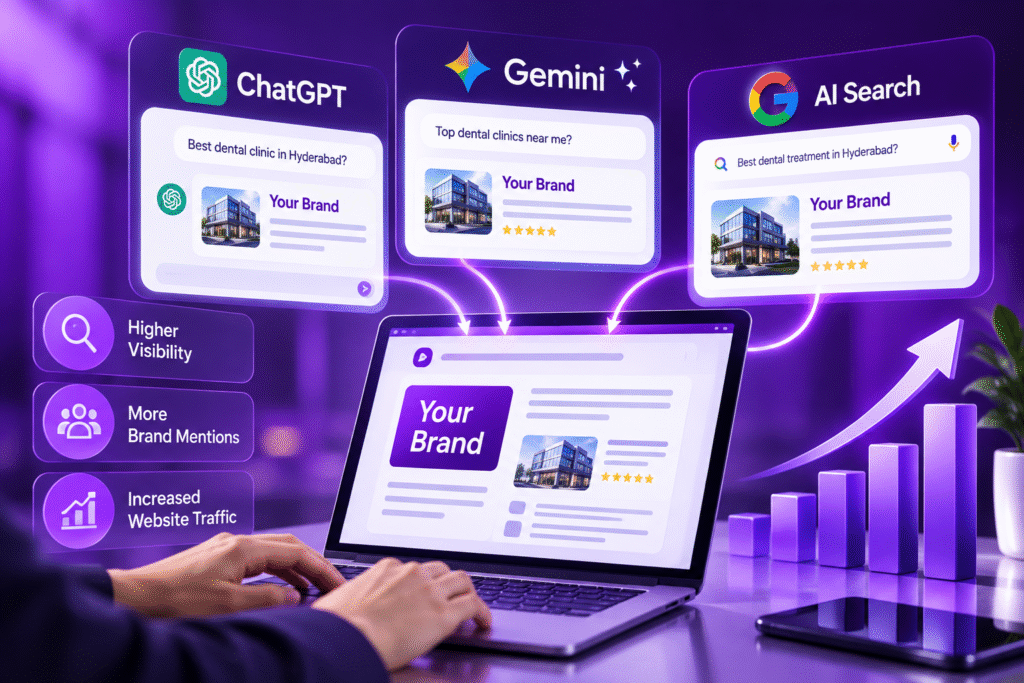
The way people search for information is changing rapidly with the growth of artificial intelligence. Instead of relying only on traditional search engines, users increasingly ask AI-powered platforms for direct answers, recommendations, comparisons, and solutions. This shift has created a new opportunity for businesses to improve how their content is understood and referenced by AI systems. Large Language Model Optimization in Hyderabad focuses on creating and structuring digital content so that AI systems can better understand a business, its expertise, services, and relevance to user queries.
For businesses competing in Hyderabad’s digital market, optimizing content for AI-driven discovery can complement traditional SEO strategies. It involves developing authoritative content, providing clear information, using natural language, answering user questions, and building trustworthy digital signals that can help AI systems interpret a brand accurately.
What Is Large Language Model Optimization?
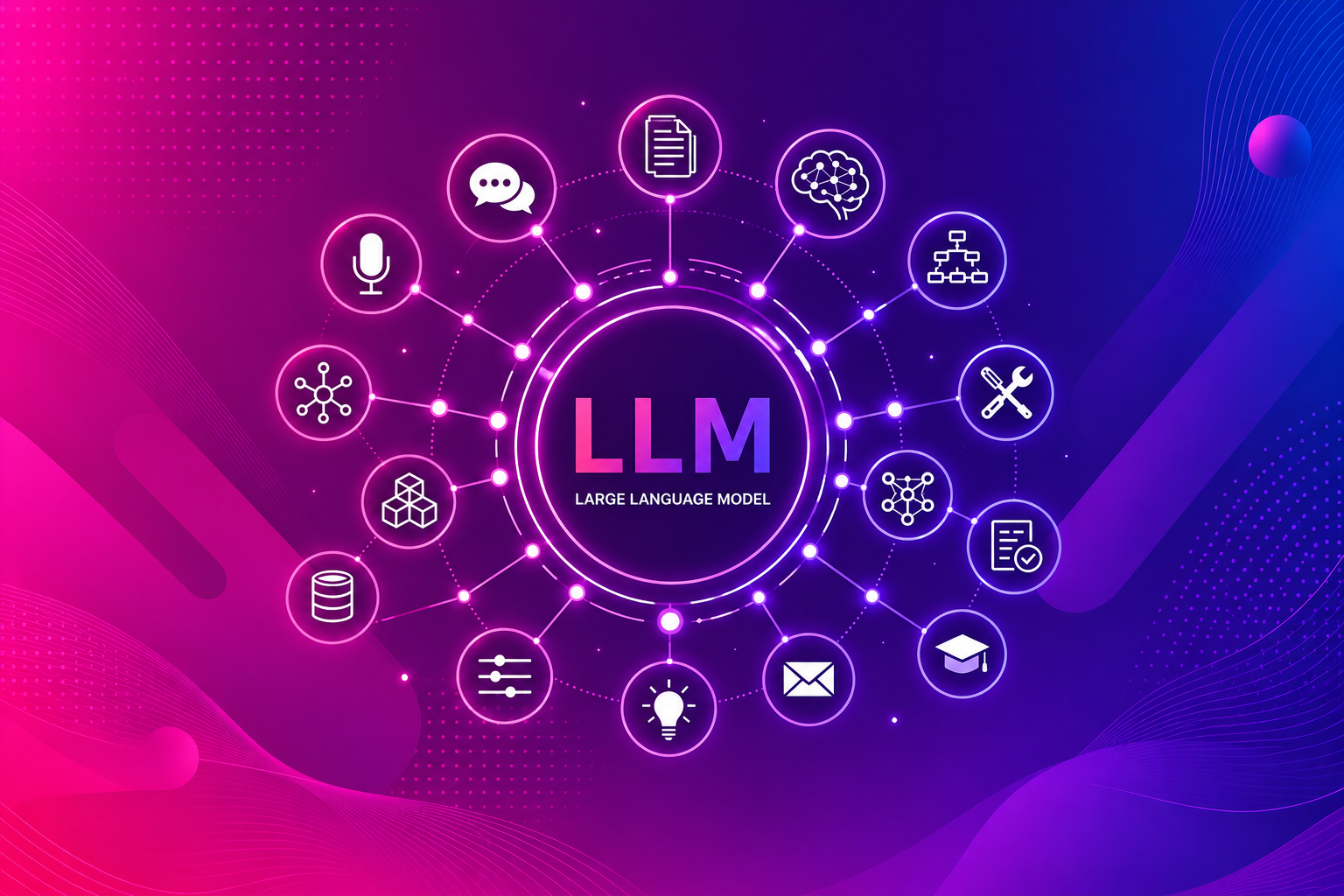
Large Language Model Optimization is the process of improving online content so that large language models can understand, interpret, and potentially use that information when generating responses to users. Large language models process enormous amounts of information and identify relationships between topics, entities, questions, and answers.
For businesses in Hyderabad, this approach can help make brand information easier for AI-powered search experiences to understand. Instead of focusing only on rankings for individual keywords, businesses can create comprehensive content that establishes topical relevance and demonstrates expertise.
The process can include optimizing website content, service pages, FAQs, business information, author profiles, structured information, and supporting content. The objective is to make information clear, consistent, useful, and contextually relevant across digital platforms.
How Does Large Language Model Optimization Work?
Large language models analyze text to understand meaning, relationships, context, and intent. When users ask questions, AI systems use their underlying knowledge and available information to formulate responses that are relevant to the query.
Optimization therefore starts with understanding what information users need. Content should answer questions directly instead of relying on excessive keyword repetition. Clear headings, descriptive paragraphs, definitions, examples, statistics, expert insights, and relevant supporting information can make content easier to interpret.
Businesses can also strengthen their digital presence by maintaining consistent information across their website and other trusted platforms. When information about a company, service, location, or expertise is clear and consistent, it becomes easier for AI systems to establish context around the business.
Why Is Large Language Model Optimization Important?
Traditional search behavior often involves users entering a keyword and selecting one of several search results. AI search changes this experience by providing conversational answers that may combine information from multiple sources.
This makes visibility within AI-generated answers increasingly important. Businesses that publish useful and authoritative content can improve their chances of being recognized as relevant sources for questions related to their industry.
For Hyderabad businesses, this can be particularly valuable because users frequently search for location-specific services, recommendations, pricing information, comparisons, and expert guidance. Content that clearly connects a business’s expertise with specific customer needs can support stronger visibility across both traditional and AI-driven search experiences
Key Benefits of Large Language Model Optimization
Improved AI Visibility
Well-structured content gives AI systems clearer information about a business and its expertise. This can support stronger visibility when users ask questions related to the company’s products, services, or industry.
Better Content Understanding
Clear explanations and logical content structures help systems identify topics, entities, relationships, and user intent more effectively.
Stronger Topical Authority
Publishing detailed content around related topics can demonstrate expertise. Instead of creating isolated pages for individual keywords, businesses can build topic clusters that cover a subject comprehensively.
Enhanced User Experience
Content designed for AI understanding is also often easier for people to read. Direct answers, descriptive headings, concise explanations, and useful examples help visitors find information quickly.
Support for Long-Term Search Strategies
AI search is developing alongside traditional search rather than necessarily replacing it. Businesses can therefore combine conventional SEO with AI-focused content strategies to create a broader search visibility approach.
What Is an LLM Model?
An llm model is a type of artificial intelligence model trained on large volumes of text and other data to understand and generate human-like language. These models can perform tasks such as answering questions, summarizing information, translating text, generating content, analyzing documents, and assisting with research.
An llm model works by identifying patterns and relationships within the data used during training. When given a prompt, it predicts and generates a suitable sequence of language based on the context it receives.
Different models may vary in architecture, training data, capabilities, context length, reasoning performance, and licensing. This is why businesses and developers evaluate models according to their specific requirements rather than treating every AI model as identical.
What Is an LLM Chatbot?
An llm chatbot is a conversational application powered by a language model. Unlike traditional rule-based chatbots that may respond only to predefined commands, an llm chatbot can understand natural-language questions and generate contextual responses.
Businesses can use an llm chatbot for customer support, lead qualification, product discovery, internal knowledge assistance, appointment-related queries, and frequently asked questions. When properly connected to reliable business information, these systems can provide customers with faster access to relevant information.
For example, a company can create an AI assistant that understands its services, operating information, policies, and common customer questions. The chatbot can then communicate this information in a conversational format.
Large Language Models Examples
There are many large language models examples available across commercial, research, and open-source ecosystems. Models differ in their capabilities, licensing structures, deployment options, context windows, multimodal support, and performance.
Some commonly discussed large language models examples include GPT-family models, Claude-family models, Gemini-family models, Llama-family models, and Mistral-family models. These models are used for applications ranging from conversational assistants and content generation to coding, document analysis, and business automation.
Looking at large language models examples is useful when evaluating which model or AI ecosystem is appropriate for a particular use case. Businesses should consider factors such as accuracy, cost, privacy, scalability, integration requirements, and deployment flexibility.
How Large Language Models Are Used in Digital Marketing
AI is increasingly becoming part of modern digital marketing workflows. Marketers can use language models for content research, topic ideation, customer-question analysis, content drafting, summarization, personalization, and campaign assistance.
However, AI-generated content still needs human review. Businesses should verify facts, maintain brand consistency, add original insights, and ensure that content genuinely addresses customer needs.
AI can also help marketers understand conversational search behavior. Instead of targeting only short keywords, marketers can analyze complete questions and longer conversational queries. This can help businesses create content that addresses the intent behind searches.
What Are Open Source LLM Models?
Open source language models provide varying degrees of access to model weights, code, documentation, or development resources, depending on their specific license. Open source llm models can give organizations greater flexibility to customize AI solutions, manage deployment environments, and adapt models to specific business requirements. Unlike fully managed AI platforms, these models may allow businesses and developers to have more control over how the technology is integrated into their applications.
Organizations can use these models for applications such as AI assistants, content generation, document analysis, customer support, coding assistance, knowledge management, and business automation. Depending on the model and its license, companies may be able to run the model on their own infrastructure or through a suitable cloud environment. This can provide greater control over data handling and system configuration while supporting customized AI workflows.
Open Source vs Proprietary
LLMs
Key differences in flexibility, customization, infrastructure and data control
| Open Source LLM Models | Proprietary LLMs |
|---|---|
| Greater deployment flexibility | Managed deployment |
| More customization options | Limited customization |
| Greater control over infrastructure | Provider-managed infrastructure |
| More control over data handling | Data handling depends on provider |
| May require technical expertise | Easier to integrate and use |
| Licensing varies by model | Provider-defined licensing and pricing |
| Can support customized AI solutions | Suitable for managed AI applications |
How to Optimize Content for Large Language Models
Effective optimization begins with creating genuinely useful content. Businesses should focus on answering real customer questions rather than producing pages solely for keyword placement.
Use Clear Content Structures
Organize information with descriptive headings and logical sections. Each section should address a specific topic or question.
Answer Questions Directly
Provide concise answers before expanding with additional explanations. This makes important information easier to identify and understand.
Demonstrate Expertise
Include accurate information, expert opinions, original research, practical examples, and relevant supporting evidence where appropriate.
Build Topic Depth
Cover important subtopics around a central subject. A comprehensive content ecosystem can demonstrate stronger topical understanding than isolated pages.
Maintain Consistent Business Information
Keep company names, services, locations, contact information, and descriptions consistent across important digital properties.
Optimize for Natural Language
People often interact with AI systems conversationally. Content should therefore address natural questions and complete search intents rather than relying exclusively on short keyword phrases.
Large Language Model Optimization for AI Search
AI search is becoming more conversational and context-driven. Users may ask questions such as “Which dental clinic provides professional teeth whitening near me?” rather than simply searching for “teeth whitening.”
Businesses can prepare for this shift by creating content that addresses complete questions, comparisons, definitions, use cases, and location-specific needs.
For companies in Hyderabad, this can include pages addressing local services, customer concerns, industry-specific questions, pricing factors, service comparisons, and frequently asked questions. The goal is to create reliable information that provides useful context for both users and AI systems.
Common Challenges in Large Language Model Optimization
One major challenge is that AI systems do not rely on a single optimization factor. There is no guaranteed formula that ensures a brand will appear in every AI-generated response.
Another challenge is maintaining content quality at scale. Publishing large amounts of repetitive or low-value AI-generated content can reduce usefulness and weaken brand credibility.
Businesses must also keep information updated. Services, prices, product details, business locations, technologies, and industry practices can change over time. Regular content reviews help ensure that published information remains accurate.
Finally, businesses need to balance AI optimization with human experience. Content should be created primarily to help people, with AI discoverability treated as an important additional objective.
Why Choose Aivolv for Open Source LLM Models?
Aivolv helps businesses explore AI-focused strategies and understand how open source llm models can support modern digital and business applications. With expertise in large language model Optimization in Hyderabad, Aivolv focuses on helping businesses improve their AI visibility, content strategy, and digital presence.
Aivolv can identify suitable AI opportunities, develop structured content strategies, and support businesses as they adapt to AI-driven search and digital experiences. The approach considers business objectives, infrastructure, data requirements, and technical capabilities.
For organizations exploring AI adoption, Aivolv goes beyond simply selecting a model. The strategy considers information architecture, content quality, integration, data governance, user experience, and ongoing optimization to create a stronger foundation for AI-powered growth.