Patients use clinic websites, search listings and social media to find practical information about care. When applying NMC guidelines for digital marketing in india 2026, healthcare teams should distinguish factual information from promotion. For healthcare teams researching NMC guidelines for digital marketing in india 2026 , the essential update is the National Medical Commission’s advertising and public communication guidelines issued on 6 October 2026. They require attention alongside the older professional ethics framework. [S1]
Responsible communication helps a patient understand available services, qualifications, costs and access. Misleading promises or pressure to seek unnecessary treatment can undermine that purpose. A credible healthcare website therefore needs more than persuasive copy: its claims, images, distribution and commercial arrangements must withstand scrutiny.
This guide explains the current framework, separates doctors’ duties from institutional requirements, and gives practical marketing recommendations. Examples are illustrative, rather than approvals for particular campaigns.
What is the National Medical Commission
The NMC is India’s statutory medical regulator under the National Medical Commission Act 2019. Its responsibilities include medical education and professional ethics; its Ethics and Medical Registration Board works within that framework. For advertising, readers must also consider State Medical Councils and the laws governing the particular establishment. The October guidelines explain these separate responsibilities. [S1, sections 4 and 10–11]
What NMC guidelines actually apply in 2026
Medical advertising rules in India may vary by advertiser type, service and the legal framework that applies. Before publishing, map the proposed message to the relevant Medical advertising rules in India and record the applicable framework.
Teams reviewing NMC advertising guidelines 2026 should document the source and approval for every factual claim. The review log should cite the relevant NMC advertising guidelines 2026 provision and explain its application.
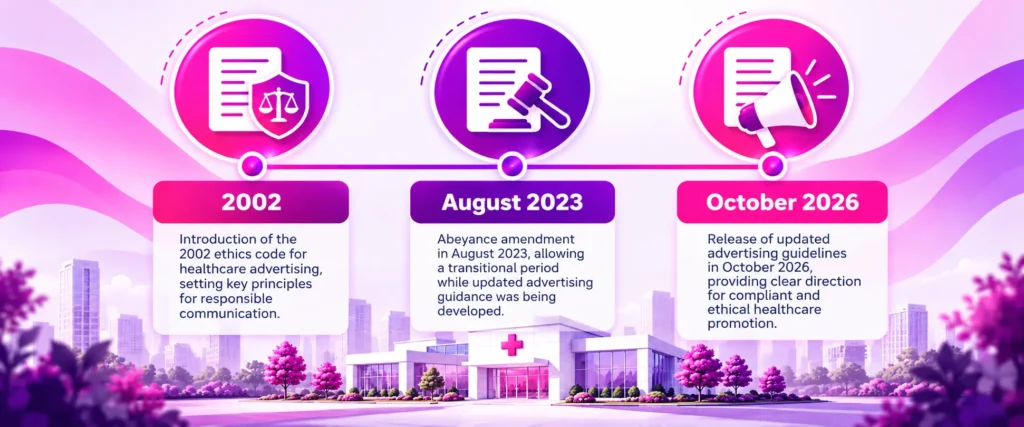
Direct answer: Read the 6 October 2026 advertising guidelines together with the operative IMC ethics regulations of 2002, as amended, and applicable law. The 2023 NMC professional conduct regulations remain listed in abeyance; the October notice does not revive them. [S1][S2][S4]
The 2023 suspension and the October 2026 update
The amendment dated 23 August 2023, published on 24 August, suspended the 2023 regulations and adopted the 2002 code. The 2026 instrument provides contemporary advertising guidance, including digital communication, while preserving statutory requirements and operative regulations. It took effect immediately on publication. [S1, sections 1–2 and 4][S2]
Hospitals and dentists need separate treatment
Institutions should review NMC guidelines for hospitals together with the laws that govern their establishment.
The October guidelines address hospitals and medical institutions, but preserve the applicable clinical establishment and state law framework. An individual doctor’s professional discipline is not identical to institutional enforcement. [S1, sections 4.3, 10.1 and 11.5]
Dentists have a separate professional framework. The National Dental Commission’s advisory of 14 October 2026 highlights potentially unethical procedure broadcasts, testimonials, before and after photographs and misleading promotion, referring to the 2014 dental ethics regulations. Dental campaigns need dental specific review. [S10]
NMC rules and Ethical considerations for Healthcare Digital Marketing
Websites and professional credentials
Regulatory position:
A hospital’s factual doctor directory can list names, recognised qualifications, specialties, registration details and availability. This differs from promotional advertising. Electronic posts require the professional disclosures specified in section 3.2, including registration status and SMR/NMR number; establishments must disclose the relevant RMP details. [S1, section 3.2 explanations III–IV and section 9.1]
Practical recommendation:
Maintain a verified credentials sheet. Check every degree, specialty and registration reference before using it in a biography, graphic or caption. A short course should never be presented as a recognised specialist qualification. For individual practitioners, NMC guidelines for doctors advertising should be part of the pre-publication review. Keep the decision record showing how NMC guidelines for doctors advertising were considered.
Testimonials and independent reviews
Regulatory position:
Fake, paid or misleading reviews are prohibited. RMPs must not request or share patient testimonials or reviews for professional promotion on social media. [S1, section 3.2 explanation V]Practical recommendation:
Do not script recovery endorsements or turn Google reviews into promotional creatives. Distinguish independently posted feedback from content requested, commissioned or republished by the practice. The existence of an unsolicited review does not make every review an unlawful advertisement. Google separately prohibits fake engagement. [S14]
Patient images and before and after content
Regulatory position:
Consent cannot legalise otherwise prohibited advertising. Promotional case displays and before and after photographs face explicit restrictions; scientific or educational use must satisfy the stated conditions and applicable law. Privacy safeguards remain necessary. [S1, sections 6, 7.4 and 8.1(v)]
Practical recommendation:
Prefer diagrams for public education. For any proposed clinical case, examine purpose, identifiability, permissions, distribution and the applicable exception. Blurring a face alone may leave a person identifiable through a voice, tattoo or surrounding details.
Claims, offers and referral arrangements
Teams should not treat Medical advertising rules in India as a single blanket permission for every channel.
The NMC advertising guidelines 2026 should be considered before a campaign is drafted, not only after it is published. Keep a dated copy of the applicable NMC advertising guidelines 2026 provisions with the approval record.
Regulatory position:
Regulatory position: Restrictions address exaggerated outcomes, fear based demand creation, prohibited endorsements and payments connected with patient procurement. Superiority claims require objective verification and must otherwise be permissible. Factual fee disclosure is distinct from inducements encouraging unnecessary care. [S1, section 8.1(i)–(xii)]
Practical recommendation:
Remove cure guarantees and unsupported rankings. Explain what a published fee includes and excludes. Review per patient agency commissions; replacing them with a retainer does not make an otherwise prohibited activity permissible.
Influencers and artificial intelligence
Teams should include the NMC social media guidelines for doctors in staff and agency publishing instructions.
Regulatory position:
An intermediary cannot do indirectly what the practitioner or institution cannot do directly. Lawful informational collaborations require appropriate commercial disclosures. ASCI adds its own qualification and disclosure standards for health influencers. [S1, sections 4.4 and 8.1(xi)][S11]
Section 7.2 prohibits AI-generated promotional campaigns furthering commercial interests and sets conditions for conforming AI content. It also addresses fabricated representations, synthetic endorsements, disclosure and patient data inputs. An AI label is not a workaround. [S1, section 7.2]
Practical recommendation:
Avoid synthetic patients and altered clinical outcomes. Escalate proposed AI-assisted healthcare communications for review of purpose, content and disclosure before production.
Patient privacy and data protection
Legal position:
Existing confidentiality and applicable SPDI obligations remain relevant. The reviewed DPDP commencement notices phase in core operational duties after eighteen months from November 2025, broadly May 2027; the whole regime is not already operational in October 2026. [S7][S8][S9]
Practical recommendation:
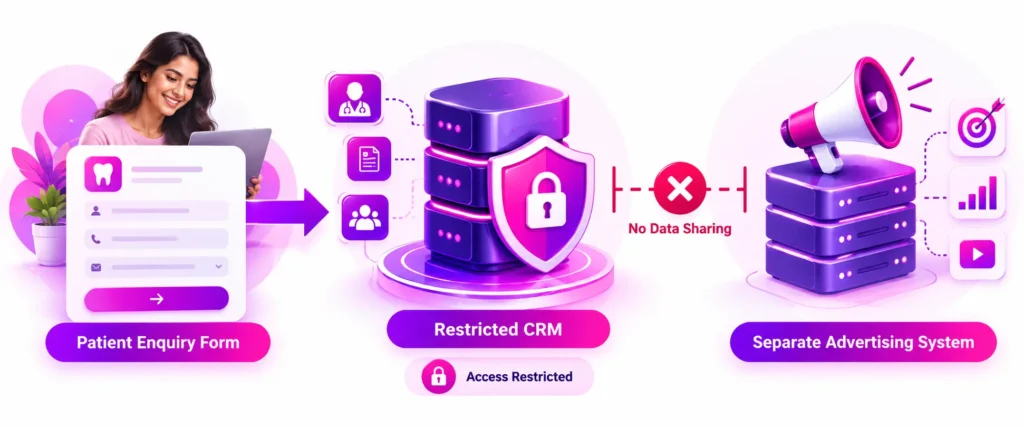
Separate treatment communications from optional marketing permissions. Collect only necessary enquiry information, restrict CRM access and examine tracking tags. Do not send diagnoses, clinical histories or identifiable appointment details to advertising platforms.
What Doctors and Clinics can and cannot do in Digital Marketing
The NMC guidelines for hospitals need to be distinguished from rules governing an individual registered medical practitioner.
Before launch, record how the NMC guidelines for doctors advertising apply to the proposed message and audience.
The classifications below are conditional summaries. They are not approvals for a specific account, establishment or creative.
Google Ads and Paid Advertising for healthcare practices
The NMC guidelines for doctors advertising do not make platform approval equivalent to professional permission.
Can doctors advertise on Google in India? There is no blanket yes. A platform accepting an advertisement does not override professional restrictions. The NMC guidelines restrict RMP solicitation and third-party promotion; institutional communications require their own assessment under section 8.3 and applicable law. [S1]
Where a proposed communication is legally permissible, check three further layers:
- Claims and keywords: Use accurate service and location descriptions. A search query containing a superlative does not justify inserting an unsupported superlative into an ad. Avoid fear, guaranteed outcomes and unverified treatment claims.
- The complete destination: Review landing-page headlines, biographies, forms, pop-ups, testimonials and mobile displays. Relevant limitations should be clear; a small disclaimer cannot repair a misleading headline. [S6, paragraph 11]
- Platform eligibility: Google restricts some healthcare categories and requires certification for certain services and locations. Its personalised-advertising rules separately restrict sensitive health targeting. [S12][S13]
Do not use patient lists or treatment related visits to build sensitive audience segments. Review remarketing and automated asset creation for the actual service and policy category. Measure lawful enquiries without treating patient procurement as a commission based agency deliverable.
| Digital marketing activity | Generally permissible / restricted / conditional | Applicable authority | Practical guidance |
|---|---|---|---|
|
Factual hospital directory |
Conditional permission |
NMC 2026, 9.1 |
Verify credentials and availability. |
|
Public health explanation |
Conditional permission |
NMC 2026, 5.1 and 8.2 |
Avoid practice promotion and solicitation. |
|
Promotional doctor Google/Meta ad |
Restricted |
NMC 2026, 8.1(ii) |
No general permission from platform approval. |
|
Factual institutional advertisement |
Conditional |
NMC 2026, 8.3; establishment law |
Review format, frequency and legal scope. |
|
Promotional patient testimonial |
Restricted |
NMC 2026, 3.2 and 6.2 |
Consent does not remove the restriction. |
|
Promotional before-and-after image |
Restricted |
NMC 2026, 8.1(v) |
Do not repackage as casual education. |
|
Paid reviews or doctor rankings |
Prohibited practices |
NMC 2026, 3.2 and 9.4; Google |
No fabricated popularity or standing. |
|
Transparent fee information |
Conditional |
NMC 2026, 8.1(x) and 9.3 |
Avoid inducements or misleading omissions. |
|
Payment per referred patient |
Restricted / prohibited arrangement |
NMC 2026, 8.1(vii)–(viii) |
Review contracts and payment triggers. |
|
Technical SEO |
Conditional practical approach |
NMC content rules; search policies |
Improve access without deceptive promotion. |
|
Commercial AI promotional campaign |
Prohibited under section 7.2 |
NMC 2026 |
Disclosure does not create permission. |
NMC Guidelines for Social Media Marketing
The NMC social media guidelines for doctors apply to the full post, including its caption, thumbnail and linked page.
Instagram, Facebook, YouTube and LinkedIn are distribution channels, rather than exemptions from professional duties. The same assessment should cover a reel’s script, visual, caption, thumbnail, paid boost and linked landing page. WhatsApp messages and influencer content are also within the guidelines’ broad media coverage. [S1, sections 3.2 and 3.5]
Illustrative educational example:
A clinician explains how blood pressure is measured, common measurement errors and when general medical assessment is appropriate. The content gives balanced information and the required professional disclosures.
Illustrative risky example:
A recovery reel praises the clinician, promises a permanent cure and directs viewers to an urgent promotional offer. Calling the video “awareness” does not resolve its promotional purpose.
Keep public replies general. Move personal treatment discussions to an appropriate private clinical channel without confirming someone’s patient status. Use a written publishing process so staff, freelancers and influencers know which claims and patient materials require review. Add the NMC social media guidelines for doctors to staff onboarding and agency briefs. Recheck the NMC social media guidelines for doctors whenever a post is repurposed or boosted.
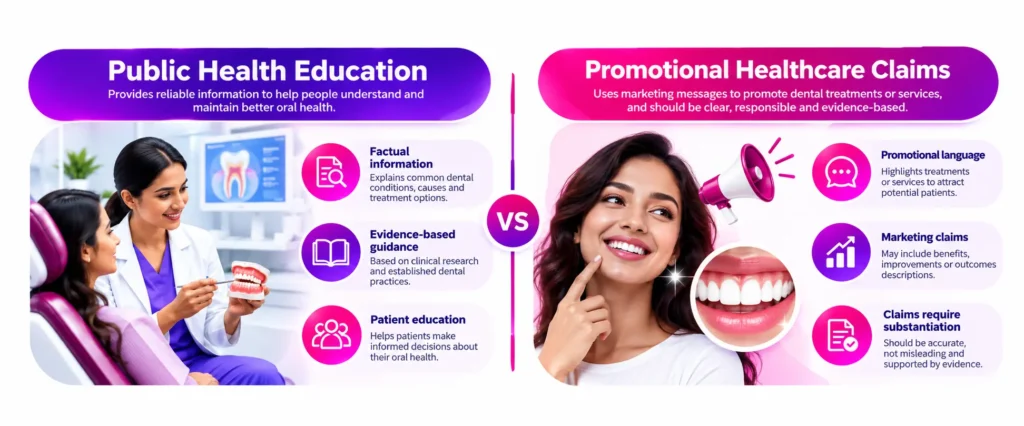
Educational content must remain educational. The guidelines permit public health participation with conditions, including restrictions on personal practice promotion and promotional monetisation. [S1, sections 5.1 and 8.2]
SEO for doctors, clinics and hospitals under applicable guidelines
An internal approval workflow can help apply NMC guidelines for hospitals consistently across departments.
SEO should make accurate information easier to find and use. The following are practical recommendations, rather than an express NMC exemption for everything described as SEO.
Local SEO and Google Business Profile
Keep names, addresses, phone numbers, operating hours and real locations consistent. Select accurate categories and correct duplicate listings. Do not create fictitious branches, add unsupported superiority claims to business names, buy reviews or pay for misleading doctor rankings. The guidelines address digital manipulation, while Google has its own review rules. [S1, sections 8.1(xii) and 9.4][S14]
Doctor profiles, educational blogs and service pages
For institution-led communications, NMC guidelines for hospitals are only one part of the review; establishment specific requirements also matter.
Use factual biographies and recognised qualifications. Explain services in plain language, including their purpose, limitations and the need for individual assessment. Publish medically reviewed educational content with sources and meaningful review dates. Avoid copying the same sales page across many cities.
For a real Hyderabad or Mumbai branch, useful details include access, available departments, hours and how to obtain administrative information. A location page needs information that helps someone use that actual location. When assessing institutional content, record how NMC guidelines for hospitals apply to the page and its claims. Revisit NMC guidelines for hospitals whenever service information or institutional campaigns are materially changed.
Reputation, FAQs and structured data
A final editorial pass should check the NMC advertising guidelines 2026 against the published version and its supporting evidence.
Respond to criticism without disclosing treatment details or pressuring reviewers. Keep FAQs visible and answer genuine questions. Use appropriate article and organisation markup that matches the page.
Google stopped showing FAQ rich results from 7 May 2026. Keep FAQs for readers, without promising enhanced listings. Google also says its AI search features do not require special additional markup or a separate optimisation scheme. Clear answers, crawlable content and accurate sources remain useful foundations. [S15][S16]
Common healthcare Digital Marketing mistakes
Review Medical advertising rules in India before using claims, endorsements, offers or patient material.
The NMC social media guidelines for doctors should inform replies, collaborations and the handling of patient related content.
Because formats differ, apply NMC advertising guidelines 2026 to the complete communication rather than only its headline.
1. Using only the 2023 rulebook.
Check the abeyance notification and October 2026 guidelines together.
2. Treating consent as advertising permission.
Check whether the content itself is prohibited before obtaining permissions.
3. Publishing unsupported treatment guarantees
Replace outcome promises with accurate explanations of assessment and limitations.
4. Assuming every institutional rule equals an RMP rule
Identify the advertiser, responsible practitioners and establishment framework.
5. Promoting unverified credentials.
Maintain evidence and correct misleading specialist descriptions.
6. Republishing patient praise as social advertising.
Review requested and adopted testimonials separately from independent feedback.
7. Buying reviews, followers or rankings.
Correct listings and improve information without fabricating standing.
8. Using discounts to pressure treatment decisions.
Review purpose, wording, exclusions and whether care is being unnecessarily induced.
9. Paying agencies for individual patient referrals.
Review the commercial arrangement and the underlying activity.
10. Calling a commercial reel educational.
Assess its actual message, editing, CTA and distribution.
11. Uploading patient data into advertising or AI systems.
Map data flows, lawful purpose, safeguards and vendor access first.
12. Accepting every AI-generated asset automatically.
Establish human review and apply the specific AI provisions.
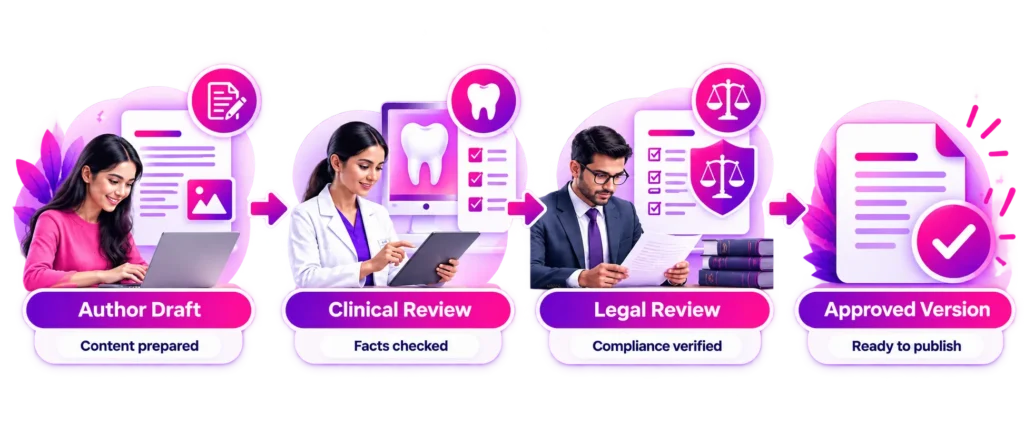
Practical compliance checklist for Healthcare Marketing in 2026
When assessing institutional campaigns, document how NMC guidelines for hospitals and applicable state law affect the content.
Check each proposed reel against the NMC social media guidelines for doctors before scheduling or boosting it.
Review the NMC guidelines for doctors advertising alongside the operative ethics code and relevant state requirements.
Use a checklist based on NMC advertising guidelines 2026 to review captions, landing pages and paid creative together.
- Scope: Identify whether it concerns an RMP, institution or dental practice and record the relevant framework.
- Website: Verify service descriptions, registration details, qualifications, fees, contact information and privacy information.
- Advertisements: Review claims, keywords, targeting, creative, landing page and permitted distribution together.
- Social media: Check professional disclosures, captions, endorsements, offers and linked content.
- Patient material: Establish whether use is permissible before reviewing consent, anonymisation and access safeguards.
- Data: Review forms, CRM permissions, tracking events, vendors, retention and marketing preferences.
- Contracts: Remove prohibited referral linked arrangements and define responsibility for authorised material.
- Approval: Record the clinical, regulatory and editorial reviewers, evidence and approved version.
- Maintenance: Audit existing assets and document corrections; recheck official updates regularly.
Documented reviews and a recurring audit are operational recommendations. Their purpose is to make the underlying requirements workable across everyday publishing.
How Aivolv can support Healthcare Digital Marketing
Understanding Medical advertising rules in India requires checking both professional obligations and applicable consumer and establishment laws. Teams should not rely on a generic checklist in place of a context-specific review of Medical advertising rules in India.
Aivolv’s published services include technical and local SEO, SEO content development, paid-search audits and management, landing-page optimisation, and social media content and community management. [S17]
For healthcare organisations, these capabilities can be scoped around accurate website information, accessible service pages, educational content workflows and review of existing marketing assets. The appropriate scope depends on the practitioner, institution and applicable restrictions.
A clinical or legal reviewer should approve the relevant medical and regulatory decisions. A marketing engagement cannot guarantee regulatory compliance, search rankings, patient numbers or revenue. Discuss the intended work with Aivolv alongside the practice’s professional advisers.
Frequently Asked Questions
Can doctors advertise on Google in India?
Can doctors promote services on Instagram?
Apply NMC social media guidelines for doctors to organic posts as well as paid distribution.
Public health education is permitted with conditions. Professional self-promotion and solicitation remain restricted; a personal profile or an unpaid post does not create an exemption. [S1, sections 5.1 and 8.1]
What are the current NMC rules for doctor advertising?
For individual practitioners, NMC guidelines for doctors advertising should be reviewed before any public-facing promotional decision.
Read the October 2026 advertising guidelines with the operative 2002 ethics framework and applicable law. The 2023 professional conduct regulations remain listed in abeyance. [S1][S2][S4]
Can hospitals publish patient testimonials?
Are before and after treatment photographs permitted?
Promotional use faces explicit restrictions. Scientific or educational cases require the relevant conditions, privacy protection and applicable permissions; they are not a general marketing exception. [S1, sections 6 and 8.1(v)]
Can doctors run Facebook or Instagram ads?
Paid distribution does not remove NMC restrictions. Assess the professional advertising position first and then the platform’s requirements. Do not treat an approved ad as regulatory clearance. [S1, sections 3.2 and 8.1]
Is SEO allowed for medical clinics in India?
Improving access to accurate information is a defensible practical approach, subject to applicable restrictions. SEO is not a blanket exemption for promotional claims, fabricated reviews or misleading rankings. [S1, sections 8.1(xii) and 9]
Can doctors collaborate with healthcare influencers?
Only within a lawful scope. Influencers cannot provide prohibited endorsements or patient solicitation on a doctor’s behalf. Disclosures and appropriate qualifications do not override professional restrictions. [S1, section 8.1(xi)][S11]
Which medical qualifications can be displayed?
Use accurate, recognised qualifications and registration details. Do not imply specialist status without the relevant qualification, or convert a short certificate into an unsupported specialty claim. [S3, provisions 1.4.2 and 7.20]
What happens if an advertising rule is violated?
Section 10.1 lists measures an SMC may contemplate: a first-violation warning and ethics training; second-violation censure and a monetary penalty where authorised; third-violation suspension of three to six months; serious-violation suspension of six to twelve months; and register removal of one to three years for repeated violations. These are not automatic sanctions. Lawful authority, notice, an opportunity to explain, reasoned orders and appeals matter. Hospital enforcement follows applicable establishment law; consumer-law consequences may separately arise. [S1, sections 10–11][S5]
Is educational medical content considered advertising?
Not automatically. Genuine public health education can fall outside promotional advertising, but content and distribution matter. A sales message disguised as awareness does not acquire an educational exemption. [S1, sections 3.2 and 5.1]
Conclusion
Understanding NMC guidelines for digital marketing in 2026 starts with the correct documents and the specific communication being proposed. The October guidelines, operative professional ethics rules and applicable institutional laws all matter.
Build visibility through information that helps patients make informed decisions. A practical review of NMC guidelines for digital marketing in india 2026 should be part of that process. Review existing assets, document evidence and permissions, and retain professional oversight of medical and regulatory decisions. To discuss website information, SEO or content workflows, contact Aivolv.
Disclaimer: This article provides general information based on sources checked on 23 October 2026. It is not individual legal or medical advice or regulatory approval. Requirements depend on the practitioner, establishment, state, service and communication; obtain appropriate professional advice and check subsequent official updates.